















The moment a student reviews a Spanish master’s program, questions about recognition, work eligibility, and language requirements loom larger than tuition or city life. Every choice, from official versus university-specific degrees to English or Spanish instruction and intake timing, carries implications for career mobility and long-term outcomes.
Let us address these structural and regulatory details that have a huge potential to shape future opportunities and transform the decision from selecting a program to planning a sustainable academic and professional path in Spain.
Masters In Spain: Is It Academically And Professionally Worth It?
The decision to pursue a master’s degree in Spain is usually tied to how well the qualification holds up after graduation. Indian students and parents assess recognition, employment relevance, and financial feasibility before committing to a country. In Spain, these outcomes depend on how master’s degrees are regulated and evaluated rather than on institutional branding alone.
Degree recognition and academic validity
Official Master’s degrees listed in the RUCT registry are approved by the Spanish Ministry of Universities and aligned with the Bologna Process. This structure supports EU wide recognition and credit transfer, which affects eligibility for further study, professional licensing, and academic mobility for Indian graduates.
Employment relevance and employer perception
Spanish universities maintain strong employer visibility within Europe. A good number of universities have consistent graduate employment outcomes, and multiple Spanish universities rank highly for employer reputation according to QS world university rankings. This influences how a Spanish master’s degree is assessed during hiring and doctoral admissions.
Cost structure and return on investment
Public university tuition typically ranges between €1,000 and €3,000 per year, lower than comparable programs in the UK or Canada. Combined with part time work rights of up to 20 hours per week, this cost model supports predictable financial planning for Indian students.
Master’s degrees in Spain have structural differences that affect recognition, employability, and visa eligibility for Indian students.
Official Master’s Vs University Master’s And Why It Matters
- Official masters in Spain is a state-endorsed (RUCT), recognized for regulated professions and PhD eligibility.
- University Masters in Spain is institution-specific, focuses on niche skills, no state verification.
- Indian priority: Official Master’s preferred for visa approvals, work permit conversions, and AIU recognition.
- Career impact: Official masters in Spain enable EU job market access; University diplomas risk non-equivalence outside Spain.
Credit System, Duration, And Thesis Requirements
For the 2025/26 academic year, Master’s degrees in Spain follow the ECTS (European Credit Transfer System), which standardizes the workload to ensure your qualification is recognized across Europe.
- The ECTS Framework: Most programs require 60 to 120 credits.
- 60 Credits: Typically completed in 1 year.
- 90–120 Credits: Typically completed over 1.5 to 2 years.
- Academic Timeline: A standard 60-ECTS Master’s consists of a Teaching Phase (September–July) followed by 3–6 months dedicated to the Master’s Thesis (TFM). While classes may end in summer, the full degree cycle often spans 12 months total.
- The Master’s Thesis (TFM): This is a mandatory final project worth 6 to 30 ECTS (~25% of the total degree). Students must choose between a research-based or practical/professional project and successfully pass an oral defense before an academic committee.
- Visa Compliance: To maintain a valid student visa in 2025, non-EU students must remain enrolled full-time, which is defined as a minimum of 60 ECTS per academic year.
Masters Degree In Spain: Eligibility And Entry Criteria
Degree Background, GPA, And Gap Acceptance
- Related bachelor’s degree required.
- GPA equivalent ~60–65% (e.g., 2.5/4.0), varies by university.
- 1–2 year academic gaps accepted with work experience or SOP justification.
- No universal GPA cutoff; universities assess holistically using transcripts, letters of recommendation, and CV.
- Entrance exams or interviews may be required for competitive programs such as MBA.
English-Taught Programs Vs Spanish Language Reality
- 100+ English-taught Master’s programs available (e.g., TEFL at UNIR, Data Science); IELTS 6.0–6.5 or TOEFL 80–90 required.
- Spanish-taught programs remain dominant; DELE or SIELE certification needed for local language programs.
- Outside business and technology fields, English options are limited, which can affect integration into local job markets.
- Indian students often prefer English programs in Madrid or Barcelona to avoid language barriers.
Masters In Spain For Indian Students: Practical Considerations
Recognition Of Indian Degrees
- Homologacion (Ministry of Education) equates Indian bachelor’s degree to Spanish level for admission; processing can take months, provisional enrollment possible.
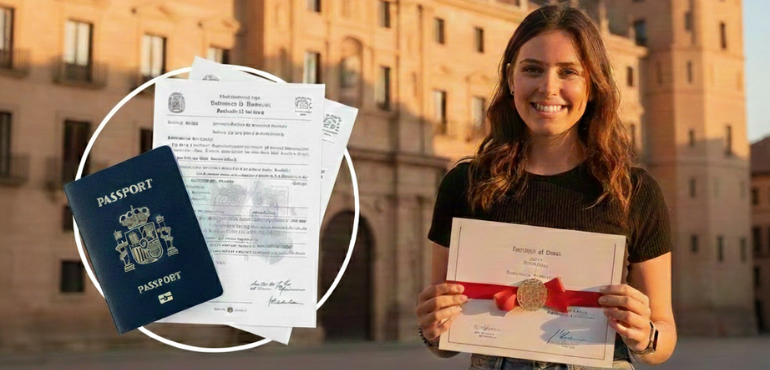
- Required documents: degree certificate, transcripts, passport, apostille; non-EU students must complete this for Master’s entry.
- Some universities provide partial recognition to allow faster access.
Intake Timelines And Academic Calendar Mismatch
- Main intake: Fall (September/October, classes Oct–June); Spring intake limited (February).
- Applications typically open March–June of the prior year.
- The Indian academic calendar may not align; results in May–June require early preparation for deadlines 8–9 months before intake.
- Official Master’s programs may have 2–3 application rounds between January and July.
Scholarships In Spain: What Is Realistic And What Is Not
University merit and need-based scholarships: ESADE offers up to 75% tuition support, UIC provides around 50%, and UAM or Valencia award partial tuition grants. Indian students with strong academic records are eligible for these programs.
Erasmus Mundus programs: These joint Master’s degrees, which can include Spanish universities, provide full funding covering tuition, travel, and living expenses. They are highly competitive and open to international applicants.
Partial tuition support: Most other scholarships focus on covering a portion of tuition rather than full costs. Students should prioritize applications that match their profile and program goals.
Spain Student Visa Process For Master’s Students
The Spain student visa process for master’s students follows a clear sequence of steps that must be completed well before the program start date.
- Apply for a Type D long-stay visa at BLS centers in Delhi or Mumbai, ideally 3–6 months before classes begin. Required documents include the admission letter, proof of funds (around 8 lakh INR), health insurance, accommodation details, and academic transcripts. Only full-time Official Master’s programs qualify.
- Upon arrival in Spain, register for the TIE (Foreigner Identity Card) within 30 days. Processing typically takes 1–3 months.
- Work rights during studies are 30 hours per week during both holidays and semester sessions. Both on-campus and off-campus employment is allowed if it does not interfere with studies, and paid internships count toward this limit. Non-EU students are not permitted to engage in self-employment.
Work Permit Conversion And Long-Term Stay Options
Post-Study Job Search Visa
After completing a master’s degree, graduates can apply for a one-year job search visa (extended under 2025 regulations for eligible degrees). If a job offer is secured, this visa can be converted into a work permit.
Long-Term Residency
To gain permanent residency, you must reside in Spain for five years. However, years spent on a student visa count only as 50% toward this total. Once you transition to a full work permit, the residency “clock” begins to count at 100%.
Non-EU Employment Path
For non-EU graduates, an employer must sponsor the residence and work authorization to enable continued stay and employment beyond the initial post-study period.
These pathways allow Indian students to transition from study to professional life while aligning with Spanish immigration requirements and long-term planning.
Frequently Asked Questions
How many hours can I work on a Spanish student visa in 2025?
Master’s students in Spain can work up to thirty hours per week during the academic term. This right is automatically included in the student residence card for recognized university programs, so no separate work permit is required.
How much money do I need to show for my visa application?
In 2025, students must prove financial means equal to one hundred percent of the IPREM, set at six hundred euros per month. For a one-year Master’s program, this means showing seven thousand two hundred euros, with additional funds required for dependents.
Does my time as a student count toward permanent residency?
Yes, but only partially. Time spent on a student visa is counted at fifty percent toward permanent residency. For example, two years of study are considered one year of residency, and full counting begins only after switching to a work permit.
Can I apply for a job search visa after my Master’s?
Yes. After completing an official degree, you can apply for a job search visa that allows you to stay in Spain for twelve months to find work or start a business. This visa cannot be renewed and must be converted to a work permit.
Is it still necessary to renew my student visa every year?
In most cases, no. If your Master’s program lasts longer than one year, the student authorization can cover the full duration of the course. You only need to renew the physical residence card each year.